
What Makes a Greenhouse Suitable for Year-Round Growing?
Plenty of greenhouses look ready for winter and simply aren't. The glazing might be solid, the frame sturdy, and the whole structure still can't hold a usable temperature once the nights drop below freezing for weeks at a time. That gap between "greenhouse" and "year-round greenhouse" trips up more growers than any pest or disease ever will. This guide breaks down what actually separates the two: the structural choices, heating math, and light realities that decide whether a greenhouse keeps producing through January or just sits there, cold and empty, until spring.
Why "Greenhouse" Doesn't Automatically Mean "Year-Round"
Ask ten greenhouse owners if their structure grows food in January, and you'll get ten different answers, most of them some version of "sort of." A greenhouse traps solar heat during the day. That's the whole mechanism, and it's a good one. But daytime heat gain doesn't do much for a bed of lettuce at 2 a.m. when the outside temperature has dropped into the teens.
This is the gap that trips up a lot of new growers. They buy or build a greenhouse, watch it perform beautifully from April through October, then wonder why everything collapses the first hard freeze. The structure wasn't broken. It just was never built for that job.
Year-round growing asks more of a structure than season-extension does. It means holding usable temperatures through the coldest nights of the year, managing humidity when the air outside is bone dry or saturated with snow, and still giving plants enough light to keep photosynthesizing when the sun barely clears the horizon. A greenhouse that does all three isn't a fundamentally different kind of building. It's a regular greenhouse with a handful of specific systems layered in on purpose.
Structural Foundations: Framing, Glazing, and Foundation
Everything else in this article depends on the building holding its shape and its heat. Skip this part, and no heater or fan setup will fully compensate.
Framing. Aluminum frames are common and low-maintenance, but they conduct cold straight through to the inside surface, which is where condensation and frost pockets tend to form. Galvanized steel and wood frames insulate a bit better at the connection points, though wood needs more upkeep in humid environments. For snow country, frame strength matters as much as material. A structure rated for light snow loads in Georgia won't necessarily survive a wet, heavy snowfall in Vermont.
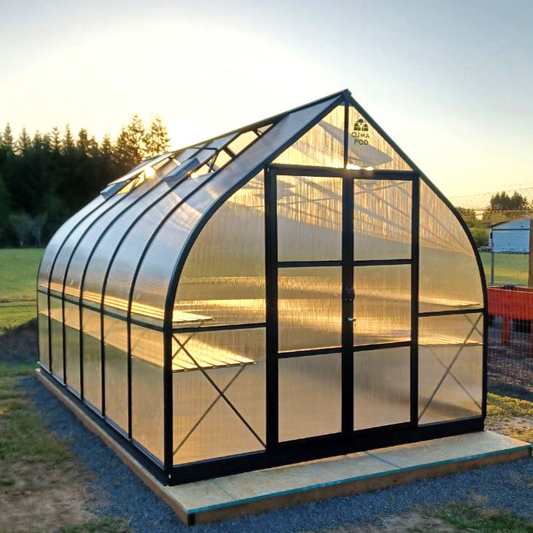
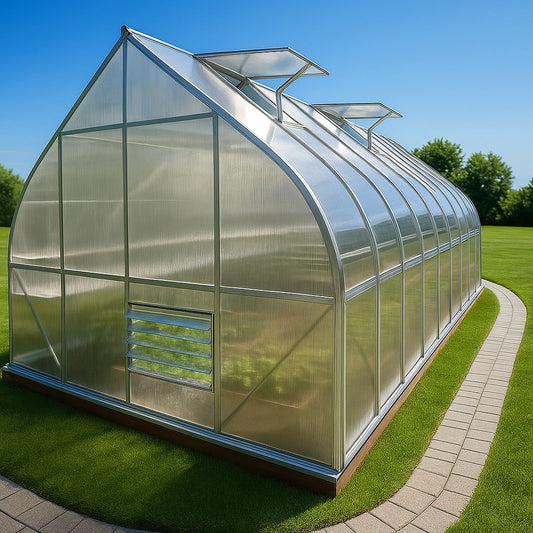
Glazing (the covering material, whether glass, polycarbonate, or poly film). This is where most of the winter performance is won or lost. Single-layer glass or single-layer poly film loses heat almost as fast as it gains it. For serious cold-season growing, double-wall polycarbonate panels are the workhorse choice in the greenhouse industry, largely because the air gap between layers acts as insulation, similar to a double-pane window. Twin-wall polycarbonate is common on entry-level structures; triple-wall or multiwall polycarbonate performs noticeably better in harsher climates.
Double-layer inflated poly film, where a small blower keeps two layers of film separated by a cushion of air, is the commercial-scale equivalent and can be a cost-effective option for larger DIY builds.
Foundation. A greenhouse without a proper foundation loses heat through the ground edges and is more vulnerable to frost heave, wind uplift, and pest entry. For year-round use, a poured concrete perimeter, treated lumber base, or at minimum a well-anchored gravel footing with a vapor barrier makes a measurable difference in how well the structure holds temperature overnight.

Insulation and Heat Retention
Glazing handles most of the insulation job, but it's not the only lever. A few additions make a real difference once temperatures drop below freezing regularly.
- Thermal mass: Water barrels, stone beds, or even large dark-colored containers absorb heat during the day and release it slowly overnight, smoothing out the temperature swing between sunny afternoons and cold nights.
- Bubble insulation film: Applied to the interior of the glazing (usually on the north-facing or coldest side), this can reduce heat loss significantly, though it also cuts incoming light, so it's typically used selectively rather than across the whole structure.
- Ground insulation: Rigid foam board buried a foot or two around the perimeter reduces the amount of heat that simply leaches into the surrounding soil.
- Sealing gaps: This sounds basic, but gaps around doors, vents, and panel seams are one of the single biggest sources of unplanned heat loss in a greenhouse. A structure that's otherwise well insulated can still run cold if the door doesn't seal properly.
Heating Systems and Realistic Expectations
Even a well-insulated greenhouse in most of the continental US needs supplemental heat to keep growing through winter. The question isn't really whether to heat, but how much, and what the target temperature actually needs to be.
Most cold-hardy winter crops (spinach, kale, certain lettuce varieties, many brassicas) tolerate greenhouse temperatures down into the high 30s to low 40s Fahrenheit without major damage. Warm-season crops like tomatoes or peppers need nighttime lows to stay above roughly 55°F to keep producing, and ideally closer to 60°F to avoid stress that shows up as dropped blossoms or slowed fruiting.
Common heating options, roughly in order of typical cost per square foot to operate:
- Passive solar and thermal mass only: Works in mild climates (roughly USDA zones 8 and warmer) or for cold-tolerant crops only. Not sufficient on its own for warm-season crops through a real winter in most of the country.
- Electric space heaters: Simple to install, easy to control with a thermostat, but can get expensive to run in colder regions and require a reliable, adequately rated electrical circuit.
- Propane or natural gas heaters: More powerful per dollar of fuel than electric in many regions, but they need ventilation to the outside since combustion produces moisture and, in the case of unvented units, carbon dioxide and other combustion byproducts that can build up.
- Geothermal or ground-source systems: Higher upfront cost, lower ongoing operating cost, and a good fit for growers who plan to run the greenhouse year-round for many years.
Whatever the heat source, a decent thermostat and a backup thermometer with a min/max memory function are worth the small expense. Guessing at greenhouse temperature by feel is a common way to lose a winter's worth of work to a single cold snap.
Ventilation and Airflow, Even in Winter
It's a fair question: why does a heated greenhouse need ventilation in the dead of winter? The answer is humidity and disease pressure, not temperature.
A sealed, heated greenhouse full of transpiring plants builds up humidity fast. Combine that with cold glazing surfaces, where warm moist air condenses, and you get the conditions that fungal diseases like botrytis (gray mold) and powdery mildew thrive in. Growers who seal everything up tight to conserve heat often end up trading a cold problem for a disease problem.
The fix isn't opening vents wide and losing all that carefully retained heat. It's smaller, more controlled airflow: a circulation fan running continuously to keep air moving and prevent stagnant, humid pockets, paired with brief, timed venting on milder days or during the warmest part of the afternoon.

Managing Light When the Days Get Short
Heat gets most of the attention in winter greenhouse conversations, but light is the quieter limiting factor, especially north of about the 40th parallel, where winter daylight can drop to nine hours or less and the sun sits low in the sky for months.
Less daylight means less energy for photosynthesis, which shows up as slower growth, smaller yields, and crops that take noticeably longer to mature than the seed packet suggests. This isn't a flaw in the greenhouse. It's basic plant physiology, and no amount of heating fixes it.
A few practical responses:
- Orient the structure for maximum winter sun exposure when possible, typically with the ridge line running east to west in most of the US, so the long side faces south.
- Keep glazing clean. Algae film, dust, and grime can cut light transmission by a meaningful percentage, and it's one of the easiest things to overlook.
- Choose crops that tolerate low light for the darkest months rather than fighting the season with sun-hungry crops that were never going to thrive under a December sky.
- Consider supplemental grow lighting for growers pushing warm-season crops through winter in low-light regions. LED grow lights have become efficient enough that this is now realistic for a hobby-scale setup, though it does add to the operating cost.
Soil, Beds, and Growing Method
Year-round use puts more demand on the growing medium than a single spring-to-fall season does. In-ground beds inside a greenhouse can gradually build up salts from fertilizer, along with soil-borne pests and diseases, since there's no winter freeze to reset the biology the way there is outdoors.
Raised beds with fresh or amended soil each season, and hydroponic or container systems where the growing medium can be replaced or sanitized, both sidestep this problem more easily than permanent in-ground beds. None of these approaches is inherently better. It comes down to what a given grower wants to manage and how many crop cycles they're running per year.
How Climate Zone Changes the Equation
USDA Hardiness Zones describe average annual minimum temperatures, and while they're built around outdoor perennial survival rather than greenhouse design, they're still a useful shorthand for how much of a lift a greenhouse needs to provide.
- Zones 8-10 (much of the Southeast, Gulf Coast, coastal California, parts of the Southwest): Year-round growing is achievable with modest heating, sometimes none at all for cold-tolerant crops, and the bigger challenge can actually be summer overheating rather than winter cold.
- Zones 6-7 (much of the Mid-Atlantic, parts of the Midwest, Pacific Northwest interior): A well-insulated structure with a moderate heating system handles most winter conditions, though warm-season crops still need active heat through the coldest stretch.
- Zones 3-5 (northern Midwest, interior Northeast, Mountain West, most of the Upper Great Plains): Serious insulation, a properly sized heating system, and realistic crop selection all matter. Warm-season crops through the deepest part of winter here usually require both heat and supplemental light to stay productive.
None of this means growers in colder zones can't run a productive winter greenhouse. It means the systems described earlier in this article (glazing, insulation, heating, and light) all need to be taken more seriously, and the crop list needs to be realistic about what's achievable without a commercial-scale energy budget.

A Realistic Year-Round Readiness Checklist
Before assuming a greenhouse is ready to run through winter, it's worth working through this list honestly rather than optimistically.
- Glazing is double-layer (or better) and free of major gaps or damage
- Frame and foundation are rated for local snow and wind loads
- A heating system is in place and sized for the coldest nights the region actually sees, not just the average
- A backup thermometer or temperature alert system is installed
- A circulation fan runs to prevent stagnant, humid air
- Crop selection matches the light and heat that will realistically be available each month
- Soil or growing medium plan accounts for multiple crop cycles without a reset season
A structure that's missing two or three items on this list isn't necessarily a failure. It just means winter growing there will be more limited, more crop-specific, or more hands-on than a fully equipped setup, and that's a completely reasonable place to start.
What to Actually Expect From Winter Growing

Even in a well-built, well-heated greenhouse, winter growth is slower than spring or summer growth. Lower light intensity and shorter days mean plants simply have less raw material to work with, regardless of how warm the air is. A head of lettuce that takes 45 days in May might take 60 or more in January, in the exact same greenhouse.
That's not a design flaw to troubleshoot. It's the seasonal reality of growing under a lower winter sun, and the growers who plan around it, rather than expecting summer-speed growth year-round, tend to get the most consistent results and the least frustration.
Whether that structure ends up being a simple cold frame extension, a mid-range double-wall polycarbonate greenhouse, or a fully heated and lit setup depends on climate, crop goals, and budget. The engineering principles behind all three, though, are the same ones covered here: seal the structure well, manage heat deliberately, keep air moving, and respect what winter light actually allows.