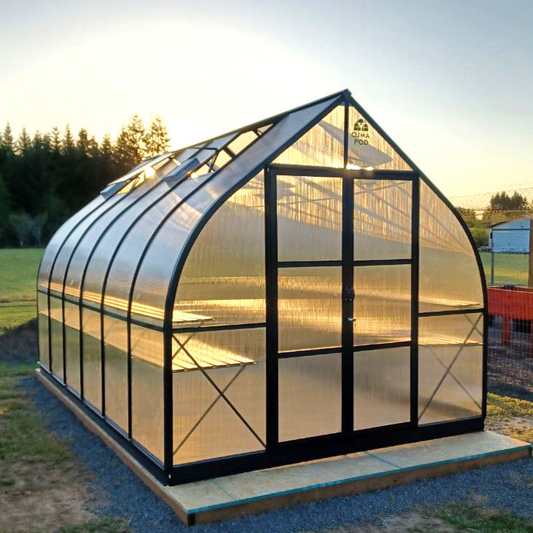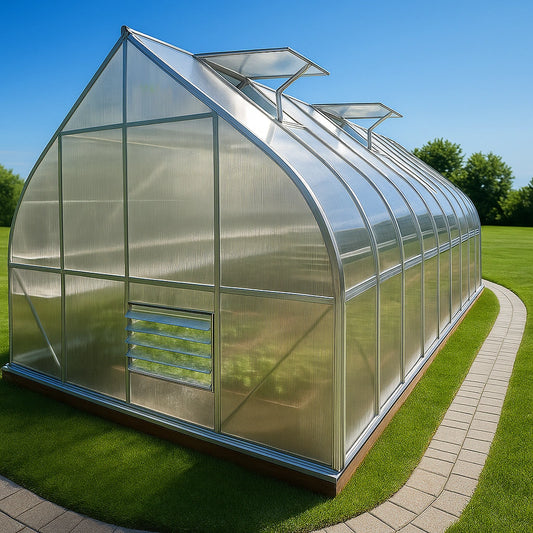

Is a 12×14 Greenhouse Big Enough to Grow Food All Year?
A 12×14 greenhouse covers 168 square feet of ground. Take out the aisle, the door end, and a spot to set down a watering can, and you're growing in about half of that. Whether half is enough comes down to what you mean by "year-round" and where you live.
Most people asking the question have a picture in mind. Maybe it's tomatoes in January. Maybe it's a salad bowl on the counter every week of winter. Those are very different goals, and a 12×14 treats them very differently.
What Year-Round Growing Actually Means
Gardeners use the phrase for three separate things, and mixing them up is how people end up disappointed. Here's a useful way to split them:
- Season extension. Starting seedlings earlier in spring and keeping crops going later in fall. Frost protection does most of the work.
- Cool-season winter growing. Harvesting hardy crops such as spinach, kale, lettuce, and carrots straight through winter, with little or no added heat.
- Warm-crop winter growing. Keeping tomatoes, peppers, or cucumbers producing in January. This takes steady heat and, in most of the country, supplemental lighting.
Two terms are worth pinning down. Cool-season crops are plants that grow best in cool weather, roughly 45°F to 70°F, and shrug off frost. Warm-season crops stall in the cold and are damaged by frost, which is why tomatoes belong to the third group and spinach to the second.
A 12×14 handles the first two in most U.S. climates. The third is a heating-and-lighting project, and the size of the greenhouse changes the budget more than it changes the answer.

The Space You Really Get (Once You Subtract the Aisle)
The 168 square feet is the footprint, the patch of ground the structure covers. Plants only grow in part of it.
The most workable layout for a house this size puts a bed or bench along each long wall with an aisle down the middle. Beds about 4 feet deep are the practical ceiling, since that's roughly as far as most people can reach from one side without stepping into the soil. Add a 3-foot aisle and the width comes to 11 feet, which leaves a foot of the 12 for wall posts, shelving, or a wider walkway. Along the length, the door end usually claims 2 to 3 feet. Two beds of 4 by 11 feet add up to 88 square feet.
That sounds modest until you translate it into plants. A trellised indeterminate tomato (a variety that keeps growing and setting fruit until cold or disease stops it, instead of topping out at a set height) wants about 18 to 24 inches of row length. One 11-foot bed holds five or six. Fill both sides with tomatoes and you own a tomato greenhouse with no room left for anything else.

Space also has a ceiling of a different kind. A crowded bed holds fewer plants than it seems to, because the ones in the middle stop performing.
Winter Daylight and What It Does to Growth
Heat gets the attention. Day length decides how much you actually harvest in December.
Growers who work through winter talk about the Persephone period: the weeks when daylight drops below about 10 hours and most crops essentially stop adding new growth, no matter how warm the greenhouse is. Near 40°N, roughly the latitude of Denver, Kansas City, and Philadelphia, it runs from early November to early February, give or take. Farther north it lasts longer. Seattle gets only about 8½ hours of daylight on the shortest day. Along the Gulf Coast, around 30°N, the shortest day still tops 10 hours, so the dip barely registers.
When growth stops, plants idle in place. A bed of spinach that reached full size in October can be picked leaf by leaf all winter, a bit like a living refrigerator. A bed seeded in November mostly sits at seedling size until February. The winter harvest is decided by what you planted in late summer.
Grow lights shift the equation within limits. A shelf of LED fixtures can keep seedlings and a few trays of greens moving in midwinter. Lighting an entire 12×14 strongly enough to fruit tomatoes takes many fixtures and a large electric bill, which is why most home growers leave fruiting crops out of the winter plan.
What You Can Grow Through Winter, by Climate
Your coldest nights set the heating question, and the answer shifts a lot across the country.
- Zones 3 to 5 (Upper Midwest, northern Plains, northern New England): With no heat, the greenhouse freezes in deep cold and even hardy greens stall from December through February. A small thermostat-controlled heater that only keeps the inside above freezing lets those crops hold in good condition and resume growth on sunny days.
- Zones 6 and 7 (Mid-Atlantic, Ohio Valley, central Plains, much of Tennessee): The best fit for unheated winter growing. Hardy greens under floating row cover (a lightweight fabric laid over the plants that adds a few degrees of frost protection) usually come through, and slow midwinter growth is the main limit.
- Pacific Northwest, west of the Cascades: Cold rarely causes trouble here. Gray skies and short days do. Growth is slow, slugs and mildew thrive, and ventilation matters more than heat.
- Southeast, Gulf Coast, Southern California, and the low-desert Southwest: Winter is the easy season. In the mildest spots, parts of Florida and coastal Southern California for example, peppers and tomatoes can carry through with a little help on the coldest nights. The hard season is July.

Heat, Insulation, and the Size Question
Size cuts both ways. A 12×14 holds enough air to change temperature gradually, which a 6×8 can't do. Small houses heat up fast in the sun and drop fast at dusk. On the other side, a bigger house has more glazing to lose heat through, and per square foot of growing space a small house actually loses more, because it exposes more wall and roof for every square foot of floor.
Heat leaves through the glazing at a rate that grows with the gap between inside and outside temperature. Holding 40°F on a 10°F night asks far less of a heater than holding 60°F. That gap, more than the floor area, is the number to design around.
Thermal mass, meaning material that soaks up heat by day and releases it slowly at night, helps with the margin. Dark-painted 55-gallon water barrels along the north wall are the usual choice. Expect them to smooth out swings of a few degrees, which can decide a borderline night, but they won't carry a house through a hard freeze.
Cheap fixes beat bigger heaters. Weatherstrip the door, seal gaps around vents and the base, and line the north wall and lower sidewalls with horticultural bubble wrap (UV-stabilized plastic with large air bubbles), since little light enters through those areas anyway. If you add a heater, pick a thermostat-controlled electric unit rated for damp locations, or a vented fuel heater. Unvented fuel-burning heaters release moisture and combustion gases into a space where plants and people are breathing.
Summer, the Season Nobody Plans For
Ask greenhouse owners in Phoenix, Dallas, or Atlanta about year-round growing and the answer starts with July. Lettuce bolts (sends up a flower stalk and turns bitter) once the weather turns warm. Tomatoes commonly drop blossoms when days run above roughly 90°F and nights stay above about 75°F. A closed greenhouse in summer sun gets hotter than the air outside.
Ventilation is the first defense. Many greenhouse guides suggest total vent openings equal to 15 to 20 percent of floor area, which works out to about 25 to 35 square feet in a 12×14. Many kits supply less than that. An exhaust fan fills the gap, sized by CFM (cubic feet per minute, the volume of air it moves). A common summer target is one full air change per minute, and in a house this size that lands somewhere around 1,200 to 1,500 CFM depending on roof height. Pair the fan with an intake vent on the opposite end so air sweeps across the plants.
Shade cloth does the rest. It's a knitted fabric rated by the percentage of light it blocks, and 30 to 50 percent is the common range for vegetables. In the hottest regions, many growers let the greenhouse rest for midsummer or use it under heavy shade to start fall seedlings, which need a protected start in August.

Squeezing More From 168 Square Feet
Floor area runs out quickly in a greenhouse. Air space doesn't. Tomatoes and cucumbers trained up strings or a trellis use a narrow strip of bed and a lot of height, and hanging baskets of herbs or strawberries claim volume that would otherwise sit empty above the aisle.

Succession planting helps with the rest. Instead of sowing a whole bed of lettuce at once, sow a small batch every two to three weeks, so you pick a steady handful rather than facing a glut followed by a gap. In a house this size, steady output beats a big single harvest.
A year in one 12×14 can look like this:
- Late summer to fall: Sow hardy greens and carrots in the south bed while the north bed finishes its last warm-season crop.
- Winter: Pick greens leaf by leaf and keep the benches clear for equipment, barrels, and trays.
- Late winter to early spring: Start seedlings on benches for the outdoor garden while cool-season crops hold the beds. This may be the best use of the space all year.
- Late spring to summer: Tomatoes and cucumbers go into the north bed, with basil and heat-tolerant herbs in the south bed under shade cloth.
So, Is 12×14 Enough? (It Depends on What You Call a Harvest)
For most backyard growers, yes, with a clear picture of the job. The size works well for:
- Winter salad greens, herbs, and root crops for a household, in most of the country
- Starting a full season of seedlings for an outdoor garden
- Extending tomatoes, peppers, and cucumbers several weeks at each end of the season
It runs tight for a few goals:
- Fresh tomatoes all winter in zones 7 and colder, which comes down to heat and light costs rather than floor space
- Feeding a household's staple crops, since potatoes, corn, and dry beans belong outdoors where they have room
- Growing summer crops and a large nursery operation in the same year
Before you commit to a size, write down three numbers: your average coldest night, the hours of daylight on December 21, and the three crops you most want to eat in January. If those crops are greens and roots, a 12×14 over-delivers. If they're tomatoes, you're choosing a heating and lighting system, and the greenhouse is the smaller decision.