
How to Choose the Right Greenhouse Size for Your Garden
Choosing a greenhouse often starts with a deceptively simple question: How much space do I need? The temptation is to count your plants, find a structure that fits them, and call it done. But gardeners quickly discover that a greenhouse filled with plants is not necessarily a productive greenhouse. Mature vines need room to grow, paths need to remain accessible, and you need enough space to water, prune, harvest, and simply move around without fighting through foliage. The right size is therefore less about fitting the maximum number of plants into a footprint and more about creating a growing space that will still work when your garden is at its busiest.
Why Greenhouse Size Is Harder to Choose Than It Looks
At first glance, choosing a greenhouse size seems straightforward. Measure the available area, decide how many plants you want, and choose a structure that fits.
In practice, that approach often produces a greenhouse that is technically large enough but frustratingly small to use.
The reason is simple: plants are not the only things that need space. A productive greenhouse also needs room for paths, working areas, ventilation, trellised crops, containers, tools, irrigation equipment, and the gardener who has to move among everything.
There is another consideration that is easy to underestimate: your gardening habits tend to change once you have protected growing space.
A gardener who initially plans to grow a few tomato plants may eventually add peppers, cucumbers, seed-starting trays, herbs, winter greens, propagation benches, or shelves for containers. A greenhouse that seemed spacious in spring can feel surprisingly crowded by midsummer.
For that reason, the best greenhouse size is rarely the smallest structure that will hold your initial plant list. It is the smallest structure that can comfortably support the way you realistically expect to grow.
Start With How You Plan to Grow
Before looking at greenhouse dimensions, define what the greenhouse is supposed to do.
There is a major difference between a greenhouse used primarily for starting seedlings in spring and one intended to produce vegetables throughout a long growing season. The first may need shelves and benches but relatively little floor area. The second benefits from dedicated planting beds, walking space, trellising, ventilation, and room to work around mature plants.
Ask yourself these questions:
- Will the greenhouse mainly be used for seedlings and transplants?
- Will you grow vegetables directly in the ground or in raised beds?
- Will you use containers or grow bags?
- Do you want to grow tall crops such as tomatoes and cucumbers?
- Will you grow during winter?
- Do you want space for propagation benches or shelving?
- Will you overwinter plants inside?
- Do you expect to add more crops in the future?
- Will more than one person regularly work inside?
- Will you need room for watering equipment, hand tools, carts, or storage?
The answers can change the ideal size considerably.
For example, a gardener who wants to raise spring transplants may get excellent results from a compact greenhouse with efficient shelving. A gardener growing indeterminate tomatoes, cucumbers, peppers, greens, and herbs throughout the season will usually need considerably more floor area.
Indeterminate tomatoes, for example, continue growing vertically rather than stopping at a predetermined height. They can occupy relatively little floor space while requiring substantial vertical and working space. That distinction is important when evaluating greenhouse dimensions.

How Much Greenhouse Space Do You Really Need?
One of the most useful ways to think about greenhouse size is to separate total floor area from usable growing area.
Total floor area is simply the greenhouse's footprint. A 9-by-14-foot greenhouse, for example, covers 126 square feet.
That does not mean you have 126 square feet available for planting.
Once you create a central walkway, side paths, beds, shelving, and working areas, the actual planting area may be substantially smaller. This is not wasted space. Paths are what make the planting space accessible.
A useful planning exercise is to draw your proposed greenhouse footprint on paper or mark it outdoors with stakes and string. Then place the elements you know you will need:
- Planting beds
- Walkways
- Benches or shelves
- Door clearance
- Work area
- Ventilation equipment
- Large containers or grow bags
- Watering equipment
- Vertical trellises
Then imagine the plants at their mature size, not their transplant size.
This last step is particularly important. Ten tomato seedlings may occupy very little space when planted in April, but their mature foliage can completely change the way you move through the greenhouse by June or July.
Width vs. Length: Which Matters More?
Gardeners often focus on total square footage, but greenhouse dimensions are not interchangeable. A long, narrow greenhouse and a wider greenhouse with the same floor area can behave very differently.
Width determines how much you can do across the greenhouse. It affects whether you can create one central path, two side beds, a central bed, benches, or combinations of these.
Length determines how much growing space you can add along the structure. Increasing length can be a convenient way to add planting area without dramatically changing how you move through the greenhouse.
Consider a narrow structure with a single central walkway. It may work extremely well for two long planting beds and a straightforward crop layout. A wider structure gives you more flexibility, but it also makes the internal layout more important.
Width becomes especially valuable when you want:
- Multiple planting beds
- A central walkway plus side paths
- Benches and shelves
- Large containers
- Two people working simultaneously
- Dedicated propagation space
- More complicated crop rotation
For many backyard gardeners, a modest increase in width can make a greenhouse feel substantially more usable than the same increase in length.
However, length has an important advantage: it allows you to add more growing area without necessarily making every part of the greenhouse harder to reach.
The best choice therefore depends on the internal layout rather than square footage alone.
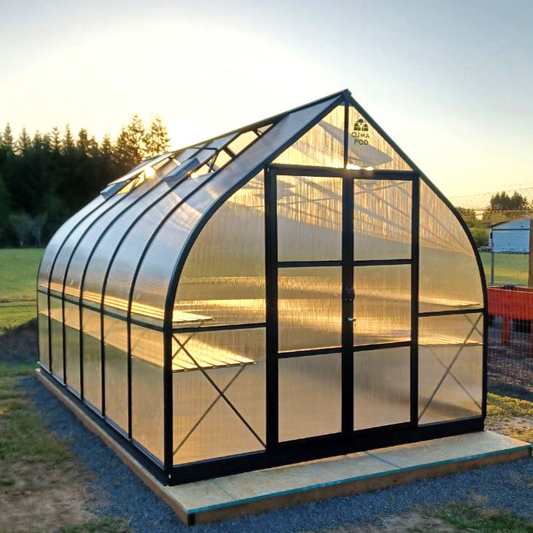
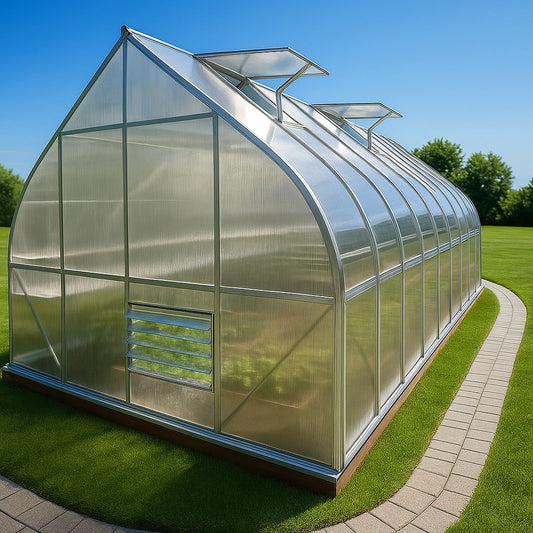
Seeing the dimensions in real greenhouse layouts can make the difference between a theoretical size comparison and a practical decision. For example, a compact greenhouse may work well for propagation and a focused crop list, while a wider or longer structure gives you more flexibility for multiple beds, trellising, and working space.
Why Width Becomes More Important as Your Greenhouse Gets Larger
In a small greenhouse, you can often get away with a simple arrangement: a path with plants on either side.
As the structure gets wider, however, you can introduce a central growing bed, additional benches, wider paths, or separate crop zones. This can dramatically increase the usefulness of the space.
There is a point, though, where adding width without a deliberate layout simply creates more floor to maintain.
The goal is not maximum empty space. The goal is efficient, comfortable access to productive growing space.
Don't Forget Paths, Work Areas, and Equipment
A greenhouse is a working environment, not simply a plant container.
You need to reach every crop for watering, pruning, harvesting, pest inspection, and disease management. You also need enough room to turn around without brushing against foliage or knocking over containers.
Think about what happens during a normal summer harvest.
You may enter carrying a basket, stop to harvest tomatoes, move around a cucumber trellis, check the undersides of pepper leaves for pests, water a container, and carry harvested produce back out.
A greenhouse layout that looks efficient on paper can become awkward when you actually perform those tasks.
Paths should therefore be planned around movement and maintenance, not simply whatever space remains after beds are drawn.
Think About Vertical Space Too
Floor area is only one dimension of greenhouse capacity.
Vertical growing can dramatically increase productivity, particularly for crops such as tomatoes and cucumbers. Shelving can also allow gardeners to use the upper portions of a greenhouse for seedlings and small containers.
But vertical space is not unlimited.
Tall plants need room above them for growth and trellising. A roof vent or other ventilation feature may occupy part of that upper zone. Plants placed against a wall may also need enough clearance to avoid interfering with airflow or maintenance.
In other words, a greenhouse can have plenty of floor area but still be poorly suited to tall crops if the height and internal layout are inadequate.

Greenhouse Size by Growing Style
Rather than asking which greenhouse size is universally best, it is more useful to match dimensions to your growing style.
For Seed Starting and Transplants
If your main objective is to start vegetable and flower plants before moving them outdoors, you may need less floor space (ClimaPod Spirit 7x7) than someone producing mature crops inside the greenhouse.
Shelving and benches become more important than raw floor area. A compact greenhouse can provide substantial propagation capacity if the layout makes good use of vertical space.
This approach is particularly useful for gardeners who already have productive outdoor beds but need a controlled environment for getting plants established.
Keep in mind that seedlings need light, airflow, water, and access. Packing multiple trays onto shelves does not automatically create a better propagation environment.
For a Small Vegetable Garden
A gardener growing tomatoes, peppers, herbs, and a few other crops may find a small-to-medium greenhouse sufficient, especially if some crops remain outdoors.
A structure around 7-by-12 (Spirit 7x12) feet can provide a meaningful amount of protected growing space when carefully organized.
The important question is whether you want the greenhouse to supplement the garden or become the garden's primary growing area.

For Serious Home Food Production
Once you are growing substantial quantities of vegetables, greenhouse size becomes much more important.
You may need dedicated beds for different crops, space for trellised plants, access for harvesting, propagation space, and room for seasonal succession planting.
Succession planting means planting the same or different crops at intervals so that harvests are spread over time rather than arriving all at once.
A longer greenhouse can be particularly useful here because it allows you to divide crops into zones and replace finished crops without disrupting everything else.
For Homesteaders and Small-Scale Growers
For more intensive food production, think beyond the number of plants.
Consider how much produce you want to harvest, how often you will be inside the greenhouse, and whether you need space for seed starting, early-season production, summer crops, fall greens, or winter protection.
At this point, the greenhouse becomes part of a broader production system rather than a single garden bed under cover.
That usually justifies planning more carefully for access, crop rotation, irrigation, ventilation, and future expansion.
Choosing a Greenhouse Size for Different Crops
The crops themselves can influence the size and shape you need.
Tomatoes
Tomatoes are a good example of why mature plant size matters.
Indeterminate varieties can grow tall and require trellising or other support. Their roots occupy relatively limited floor space, but their foliage can spread into walkways and neighboring plants.
If tomatoes are a major crop, prioritize vertical clearance and enough space between rows to inspect and harvest plants comfortably.
Cucumbers
Cucumbers can be surprisingly space-efficient when grown vertically, but their leaves and vines still require substantial room.
A trellis can turn floor area into vertical production space, but it does not eliminate the need for access. You still need to reach the plants for harvesting and disease inspection.
Peppers and Herbs
Peppers and many herbs generally make efficient greenhouse crops because they can remain relatively compact compared with vigorously climbing vines.
This makes them useful in smaller structures or along the edges of beds where taller crops would otherwise dominate.
Seedlings and Transplants
Seedlings require surprisingly little floor area individually, but trays, shelves, watering, and airflow create additional space requirements.
If propagation is a major purpose of your greenhouse, benches may be more valuable than additional ground-level beds.
Winter Greens
Leafy greens and other cool-season crops can make good use of greenhouse space outside the main summer growing period.
This is one reason a greenhouse that looks unnecessarily large during one season may prove very useful across an entire year.
How Climate Changes the Size You May Need
Greenhouse sizing is also influenced by climate.
USDA Hardiness Zones describe the average annual extreme minimum winter temperature and are useful for understanding general plant survival outdoors. They do not, by themselves, tell you exactly how a greenhouse will perform.
Two gardeners in the same hardiness zone can have very different greenhouse conditions because of sunlight, humidity, wind exposure, elevation, local frost patterns, and summer temperatures.
Climate affects greenhouse size in several ways.
Cold Winters
Gardeners in colder regions may use a greenhouse to extend the growing season or protect crops during periods when outdoor production is impossible.
If you intend to grow through winter, space for insulation strategies, thermal mass, supplemental lighting, heating equipment, or protected pathways may become relevant.
A structure used only for spring and fall extension has different requirements from one expected to support active crop growth through the coldest part of winter.
Hot Summers
In hot regions, the challenge may be excessive heat rather than cold.
Ventilation, shading, airflow, and careful crop selection become critical. A larger greenhouse is not automatically easier to cool.
In fact, adding growing space also adds volume and exposed surface area that must be managed. A large structure in a hot climate requires a deliberate ventilation strategy rather than simply more square footage.
Humid Regions
High humidity can increase disease pressure on susceptible crops, particularly when leaves remain wet or air movement is poor.
More space can make crop spacing and airflow easier, but only if the layout actually uses that space effectively.
Dry or High-Sun Regions
In arid and high-sun environments, irrigation and shading can become major considerations. A greenhouse may need more room for water management equipment and careful crop spacing.
The practical lesson is straightforward: greenhouse size should be considered together with climate control. A larger structure is useful only when you can manage the environment inside it.
Choosing Between a Small and Large Greenhouse

There is no universal advantage to going larger.
A small greenhouse can be easier to heat, clean, organize, and manage. It may also fit naturally into a suburban backyard where space is limited.
A larger greenhouse provides greater flexibility and can support more crops, but it also increases the amount of structure, growing media, irrigation, ventilation, and maintenance involved.
Consider the trade-offs carefully.
- Small greenhouse: lower space requirements, simpler organization, easier to manage, but limited room for expansion.
- Medium greenhouse: good balance for many serious home gardeners, with room for multiple crops and a functional work area.
- Large greenhouse: greater production potential and layout flexibility, but more demanding in terms of planning, environmental control, and maintenance.
The right choice depends on whether you value simplicity or flexibility more.
Planning for Future Expansion
Gardeners often make their greenhouse decision based on what they grow today.
A better approach is to consider what you are likely to grow three or five years from now.
You do not need to predict every future crop. Instead, identify how your gardening interests are likely to develop.
If you currently grow ten tomato plants and are already experimenting with seed starting, peppers, herbs, and fall greens, a greenhouse that barely accommodates the tomatoes may not remain adequate for long.
There is also a practical difference between adding length later and replacing an undersized greenhouse with a larger one.
When selecting a structure, investigate whether its design allows future expansion and whether the proposed location gives you enough room for it. Even if you never expand, leaving sensible clearance around the greenhouse can make maintenance and access easier.
Expansion should not be assumed, however. If the greenhouse design does not support it or your site cannot accommodate additional space, choose the dimensions you actually need from the beginning.
If you already know that your garden is likely to grow, it can be worth comparing larger greenhouse formats before committing to a compact footprint. A little extra room can be much easier to plan for now than to create later.

Common Greenhouse Sizing Mistakes
Choosing Based Only on the Number of Plants
Plant count does not tell you how much space you need.
Twenty compact pepper plants and twenty large indeterminate tomato plants have very different space requirements.
Think in terms of mature plant size, vertical growth, access, and crop management.
Ignoring the Gardener
The greenhouse has to accommodate the person doing the work.
You need room to bend, carry trays, harvest produce, inspect leaves, prune plants, and water without damaging neighboring crops.
Forgetting Equipment
Fans, irrigation components, shelving, containers, hoses, hand tools, and propagation equipment can consume more room than expected.
Decide where these items will go before finalizing the dimensions.
Planning Only for Summer
A greenhouse may be most crowded in summer, but its value can extend across multiple seasons.
If you intend to start seedlings in late winter, extend the fall harvest, or overwinter selected plants, include those uses in your calculations.
Assuming Bigger Automatically Means Better
A greenhouse is a controlled growing environment. The larger it becomes, the more important environmental management can become.
Do not choose a large greenhouse simply because additional floor area sounds beneficial. Choose it because you have a clear use for that space.
A Practical Greenhouse Size Decision Process
If you are still unsure which size is appropriate, work through the decision in this order.
Step 1: Define the Primary Purpose
Decide whether the greenhouse is mainly for seed starting, season extension, mature crop production, winter growing, plant protection, or a combination of these.
Step 2: Make a Crop List
Write down the crops you genuinely expect to grow rather than every crop you might someday try.
Separate them into categories such as tall crops, compact crops, containers, seedlings, and overwintered plants.
Step 3: Estimate Mature Space
Look at each crop at its expected mature size. Account for trellising and plant spread rather than relying on the size of seedlings at planting time.
Step 4: Draw the Interior Layout
Mark beds, paths, benches, shelves, work areas, and equipment.
This step often reveals sizing problems before any money is spent.
Step 5: Test Your Movement
Imagine entering the greenhouse carrying a tray or harvest basket. Can you reach every bed? Can you turn around? Can you inspect the plants along the walls? Can you access ventilation equipment?
If the answer is no, the structure is either too small or the layout needs to change.
Step 6: Consider Your Climate
Think about your local summer heat, winter temperatures, wind, humidity, sunlight, and seasonal growing goals.
Step 7: Add a Realistic Future Margin
If you already know that your garden is expanding, leave room for that growth. A modest amount of additional space can be much easier to incorporate at the planning stage than after the greenhouse is installed.

Frequently Asked Questions
What is a good greenhouse size for a beginner?
There is no single beginner size. A compact greenhouse can be an excellent choice if you primarily want to start seedlings or grow a limited number of crops. A somewhat larger structure may be more appropriate if you already have an established vegetable garden and want to produce mature crops inside.
For many beginners, a greenhouse in the roughly 7-by-12 to 9-by-14-foot range can provide a useful starting point, provided the layout matches the intended crops. The important point is not the exact dimensions but whether the space accommodates mature plants, paths, and working areas.
Is a 7-by-12-foot greenhouse big enough?
It can be. A 7-by-12-foot greenhouse provides 84 square feet of floor area, which can support a productive garden when the layout is carefully planned.
It is better suited to a focused crop list than to a large collection of mature plants, extensive shelving, and multiple working zones.
Is a 9-by-14-foot greenhouse big enough for a vegetable garden?
A 9-by-14-foot greenhouse provides 126 square feet of floor area and can support a substantial selection of vegetables when efficiently organized.
It is large enough to create more flexible bed and walkway arrangements than many compact structures, but the actual capacity depends heavily on crop choice and whether you use benches, containers, or vertical trellising.
Is a larger greenhouse easier to manage?
Not necessarily.
A larger greenhouse provides more room to organize crops and work comfortably, but it also creates more area to irrigate, ventilate, clean, inspect, and maintain.
The ideal size is the one that provides enough room for your growing system without creating unnecessary management requirements.
Should I buy the biggest greenhouse I can afford?
Not automatically.
Buy the size that matches your realistic growing goals, site, climate, and ability to manage the environment. If you already expect your garden to expand, however, it is usually worth considering that growth before settling on the smallest possible structure.
Does greenhouse width matter more than length?
Neither is universally more important. Width affects interior layout and working flexibility, while length provides additional growing space along the structure.
If you want multiple beds, benches, or working zones, additional width may be particularly valuable. If you already have a simple layout and mainly want more crop capacity, additional length may be more useful.
How much space should I leave for paths?
There is no universal path dimension that works for every greenhouse. The path should be wide enough for the way you actually work, including carrying trays, watering equipment, harvest baskets, and other tools.
Rather than adopting a single number, test your proposed layout physically. Mark the beds and paths on the ground and walk through the space while carrying the equipment you normally use.
Can I grow more plants by using shelves?
Yes, especially for seedlings, herbs, and compact plants. Shelving increases the use of vertical space and can be very effective during propagation.
However, shelves cannot replace adequate floor area for mature crops. Tall vegetables still need room for root systems, foliage, trellising, harvesting, and airflow.
Final Takeaway
The right greenhouse size is not determined by a single formula or a universal number of plants.
It comes from matching the structure to your growing goals, crop choices, climate, working habits, and plans for the future.
Start with what you want to grow. Think about those plants at full size. Then design the paths, beds, shelves, trellises, and work areas around them. Finally, make sure the greenhouse can function in your local climate and throughout the seasons when you intend to use it.
If you are deciding between two sizes and both fit your site and budget, the more useful question is not simply, "Which one holds more plants?" Ask instead, "Which one will let me grow comfortably, maintain my crops properly, and still have room for the way my garden is likely to develop?"
That is usually the better measure of greenhouse size.